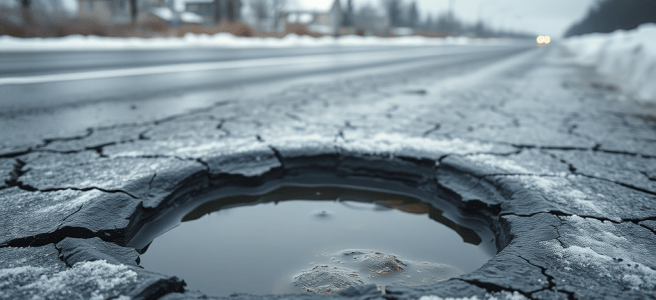
February is when UK roads quietly become hostile. Weeks of freezing nights, rain, grit and heavy traffic take their toll, and the result is potholes, often hidden, often water-filled, and often expensive.
As every car hacker knows, some common winter driving habits will cause longer-term problems for your car. So this post isn’t really about perfect winter driving, it’s more about avoiding damage before it happens.
How do potholes form?
Potholes often feel like they appear out of nowhere overnight, but this isn’t quite the science behind it. They actually form through a cold-warm temperature cycle. Here’s the theory explained in simple terms:
- Water seeps into cracks in the road
- Sub-zero overnight temperatures expand it
- Traffic breaks the weakened surface
- Rain fills the hole, hiding its depth
So by February, roads are littered with them, especially on residential streets, B-roads, rural lanes and areas near drains and junctions.
The simple driving mistake that causes most damage
Hitting potholes isn’t always avoidable, but late reactions are. Driving too close to the car in front, accelerating hard, or not scanning the road ahead leaves you no time to avoid trouble. And braking sharply in a pothole often does more harm than rolling through gently.
A Car Hacks approach to pothole avoidance
01. Look further ahead than usual
In winter, you need more visual lead time. If you’re watching only the car in front, you’ll spot potholes too late. Scan the road surface as far ahead as traffic allows, especially after rain.
02. Treat puddles as potential potholes
In February, every puddle could be a hole. Think of it like the famous Vicar of Dibley jumping-in-a-puddle scene – in fact, let’s call this the Rule of Dibley.
If you can’t see the bottom, slow gently before the puddle, adjust your line if safe, and avoid accelerating through standing water.
03. Leave extra space — it buys reaction time
Increased following distance isn’t just for ice. Space lets you see hazards earlier, change line smoothly, and avoid sudden braking or swerving.
04. Don’t swerve at the last second
Sharp steering inputs can damage tyres, knock wheels out of alignment, and cause loss of control on wet roads. If you can’t avoid a pothole safely, slow down and hit it square-on rather than clipping it at speed.
Why this matters more than you think
Pothole damage isn’t always obvious immediately. It can show up later as slow punctures, the steering pulling to one side, vibrations at speed, and uneven tyre wear, all of which cost far more than one moment of care and patience.
A very February car hack
February driving is about damage limitation, not apex-clipping. Smooth inputs, early awareness and cautious assumptions will save your wheels, tyres and suspension, and spare you an MOT surprise later in the year. More than any other time of year, in February calm and clever beats urgency every time. And that, ultimately, is what car hacking is really about.
This tip is from the author of Car Hacks – a collection of clever, low-cost ways to make everyday driving, owning and maintaining a car easier, cheaper and less frustrating. If you like practical fixes that use everyday household items (and don’t require mechanical know-how), you’ll find loads more inside the book.
 Car Hacks
One thought on “February Is Peak Pothole Season – Here’s How to Protect Your Car”