Clearing ice from your windscreen is bad enough on a winter morning, but frozen door mirrors are a special kind of annoyance. They’re awkward to scrape, easy to forget about, and useless until they’re clear.
Rather than fighting ice at the start of every journey, this hack helps you avoid it forming in the first place.
Why door mirrors freeze so easily
Door mirrors are exposed on all sides, made of plastic and glass, and cool down quickly overnight. Even when your windscreen is only lightly frosted, mirrors often end up completely iced over.
Scraping them risks scratches, and waiting for the heater to defrost them wastes time (and fuel).
The simple prevention hack
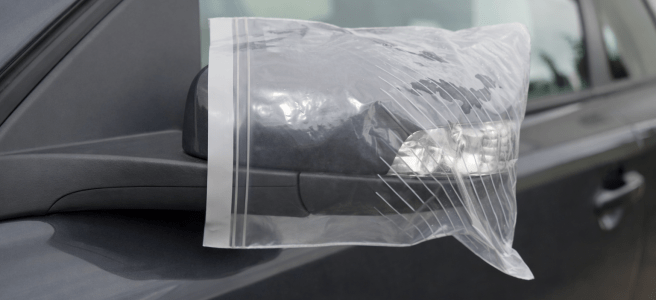
All you need is a couple of plastic freezer or zip-lock bags.
How to stop mirrors icing up
- Find two bags big enough to fully cover your mirrors
Freezer bags work best, but any clean plastic bag will do. - Slip one bag over each mirror housing
Make sure the glass is fully covered. - Lightly secure the bag
Close the zip, twist the open end, or tuck it in so it won’t blow away overnight. - Remove the bags in the morning
Your mirrors should be completely ice-free and ready to use.
Fold the bags up and keep them in the door pocket or glovebox for next time.
Why this works so well
Ice can’t form directly on the mirror surface if moisture can’t reach it. The bag creates a simple barrier, keeping frost, freezing rain and condensation off the glass entirely.
It’s the same principle as covering your windscreen, just scaled down.
A couple of practical tips
- Reuse the same bags rather than throwing them away
- If it’s windy, a small elastic band helps keep them in place
- This works just as well in snow as it does in frost
Why this is a proper car hack
- No sprays.
- No scraping.
- No money spent.
Just a bit of forward planning that makes cold mornings noticeably less irritating.
This tip is from the author of Car Hacks – a collection of clever, low-cost ways to make everyday driving, owning and maintaining a car easier, cheaper and less frustrating. If you like practical fixes that use everyday household items (and don’t require mechanical know-how), you’ll find loads more inside the book.
 Car Hacks